Remembering a World-Famous Biochemist
Radda György – biochemist, who elaborated the MRI examination – was remembered by his Alma Mater, his family and his former community of colleagues in Oxford. On this occasion, in the Benedictine Secondary School, a prize hallmarked by the researcher’s name was founded.
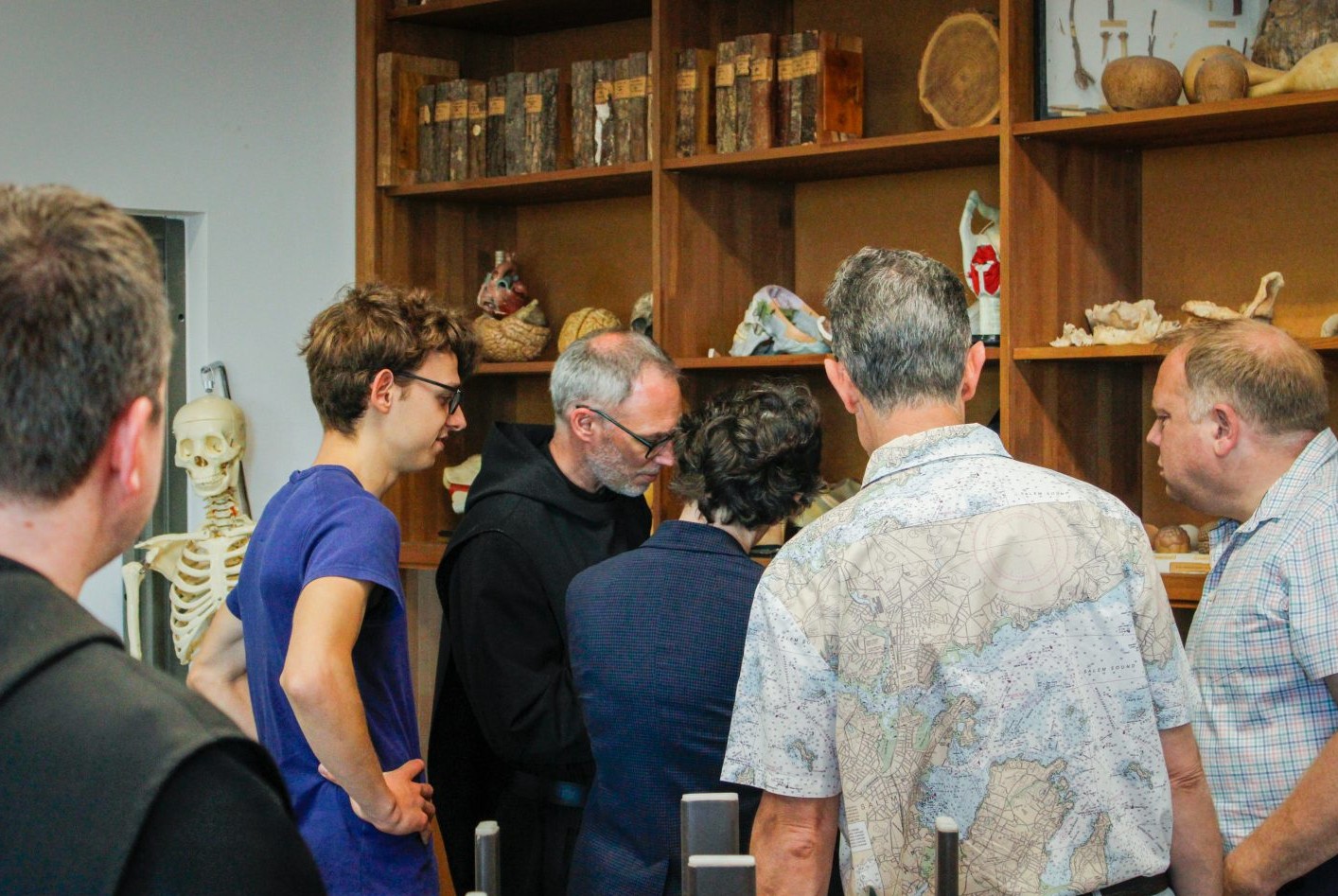
On 20th June, in the Benedictine Secondary School of Pannonhalma, a delegation from England was received, they arrived to commemorate the school’s former pupil, Sir Radda György, biochemist, who took his final examination in 1954. The members of the delegation were Irene Tracey, the Vice-Chancellor of the University of Oxford, Myles Allen, climate scientist, professor in the University of Oxford, and Radda György’s two children, Ann and Jonathan Radda. It was a personal concern for Professor Irene Tracey to visit Radda György’s former school, since she considered him as her mentor and role model. The guests visited the secondary school’s lecture-rooms of natural sciences, the collection of minerals, and they had a look at the Radda-relics kept in the school and the Archives. Vice-Chancellor Irene Tracey and Archabbot Hortobágyi T. Cirill discussed the Radda György Educational Project elaborated by the Archabbey and the secondary school; the project focuses on the development of the collections of natural sciences, it starts an integrated educational programme of natural sciences, and joining an international astronomical project is also planned.
It was followed by founding the Sir George Radda Prize to honour annually the pupils of Pannonhalma achieving outstanding results in the fields of natural sciences. The document on this was signed by Archabbot Hortobágyi T. Cirill, Ann and Jonathan Radda, and Vice-Chancellor Irene Tracey on behalf of the University of Oxford. The first pupil to be honoured with this prize was Szilágyi Barnabás of Class 12.B, who – in the schoolyear of 2024/25 – was placed first in mathematics, third in chemistry, fourth in physics in the National Secondary School Subject Competition. In addition, he won the first prize at the Szilárd Leó National Competition in Nuclear Physics, and he was placed second with the team of the Benedictine Secondary School of Pannonhalma in the CanSat Competition in Space Technology.
The prize’s plaque shows Sir Radda’s portrait, and its inscription is a part of the former and contemporary morning prayer of the Benedictine pupils: “Cooperatores operum tuorum” – “So that we could be your co-workers in your works”. Prior to his death, Radda György asked that the quotation on the plaque from the text of the Pannonhalma prayer be recited in Hungarian and in English at his funeral.
Sir Radda György and his brother and sister fled the country in November 1956, then – from Vienna – he reached Great Britain with the help of two Oxford professors. He earned his degree at that university, then acquired a PhD, and became head of department. In 1974, he was the first in the world to put down the significance of the nuclear magnetic resonance (NMR) to study tissue metabolites. Based on this, the world’s first clinical NMR-laboratory was created in the University of Oxford, where Radda György established the world’s first molecular cardiological department. He elaborated the image-making process that is called MRI today. In 1983, the world’s first magnetic resonance spectroscopy (MRS) suitable for examining the whole human body was put in working order in Oxford. Sir Radda’s lifework was acknowledged with one of the most prestigious state decorations, the Hungarian Corvin Chain in Hungary in 2018.